Philosophy
We are curious and committed early-career tribologists from universities and industry. We provide young people in tribology with a platform for exchanging experience and knowledge in a relaxed and friendly atmosphere.
We also want to inspire young people to engage with tribology. We meet regularly online and in person for working group meetings, organise the annual Young Tribological Researcher Symposium (YTRS), and collaborate on experimental projects that demonstrate tribological phenomena. As an international working group, our meetings and events are held in English.
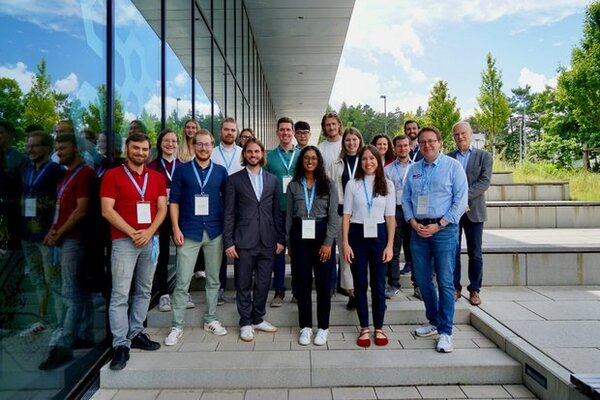
Members
The working group has around 30 active members, most—but not all—of whom are based in German-speaking countries. It is led by Klara Feile and Benedict Rothammer, both from the Chair of Engineering Design at FAU Erlangen-Nürnberg, and Christian Orgeldinger from the Chair of Engineering Design and CAD at the University of Bayreuth.

Symposia
The Young Tribologists working group organises the annual Young Tribological Researcher Symposium (YTRS), hosted by different universities each year. This international symposium provides a platform for early-career researchers.
The symposium focuses on:
- Presentations of projects and theses by early-career tribologists from academia and industry
- Discussion of tribological topics and ongoing research projects
- Networking among early-career tribologists
Experimental Projects
Teams regularly come together to develop and build experimental test rigs for teaching. The experiments are presented at exhibition stands during tribology conferences and are used as demonstration models at universities and universities of applied sciences. Our latest development is the Tribo Aid Kit. This compact and accessible tribometer can be built easily and cost-effectively and is particularly suitable for demonstrating tribological principles.
The Tribo Aid Kit
Tribometers are generally expensive and difficult to transport, making it challenging to demonstrate an experiment efficiently during a lecture or tutorial. We therefore developed a compact, lightweight and easy-to-use tribometer that reflects the functionality and complete workflow of a full-size tribometer. Naturally, its measurement accuracy cannot match that of high-end test rigs, but this is only a minor limitation for teaching and interactive demonstrations.
Best of all, it can be assembled from just a few components and several 3D-printed parts.
Where Can I Get the Tribo Aid Kit?
Right here—although not as a physical product. We will provide assembly instructions and all files required to build the Tribo Aid Kit yourself.
We are currently finalising the design and will soon make all required documents available here as free downloads.
Detailed instructions and an assembly video will provide everything you need to build the tribometer. You will then only need a 3D printer and a small number of purchased components to get started.
Are you interested in becoming an active member of Young Tribologists? You are welcome to attend one of our working group meetings or our symposium to get to know us. Both are open to non-members as well. Simply email us at young-tribologists@gft-ev.de.
To join Young Tribologists, follow these steps:
Step 1
Apply for membership in the German Society for Tribology.
Information about GfT membership is available here.
Step 2
Complete the Young Tribologists member questionnaire and send it to young-tribologists@gft-ev.de.
Step 3
Our working group thrives on active participation—for example, by helping organise the symposium or contributing to experimental projects. New project ideas are always welcome.
The international Young Tribological Researcher Symposium, organised by Young Tribologists, gives early-career tribologists a platform to present research results and build professional networks.
Is your company or organisation interested in supporting the symposium?
Further information about sponsorship opportunities is available here: